If you’ve recently searched for Repmold, you’re not alone. The term has started appearing across manufacturing and technology websites, yet many people struggle to find a clear definition. That’s because Repmold is not a standardized industry term. Instead, it’s commonly used as an umbrella concept for mold replication, rapid tooling, reverse engineering, digital mold design, and modern manufacturing workflows. Different sources use it differently, so understanding the technology behind the name is more valuable than focusing on the label itself.
This guide explains what Repmold generally means, how it works, where it’s used, and why digital manufacturing continues to reshape product development in 2026.
What Is Repmold?
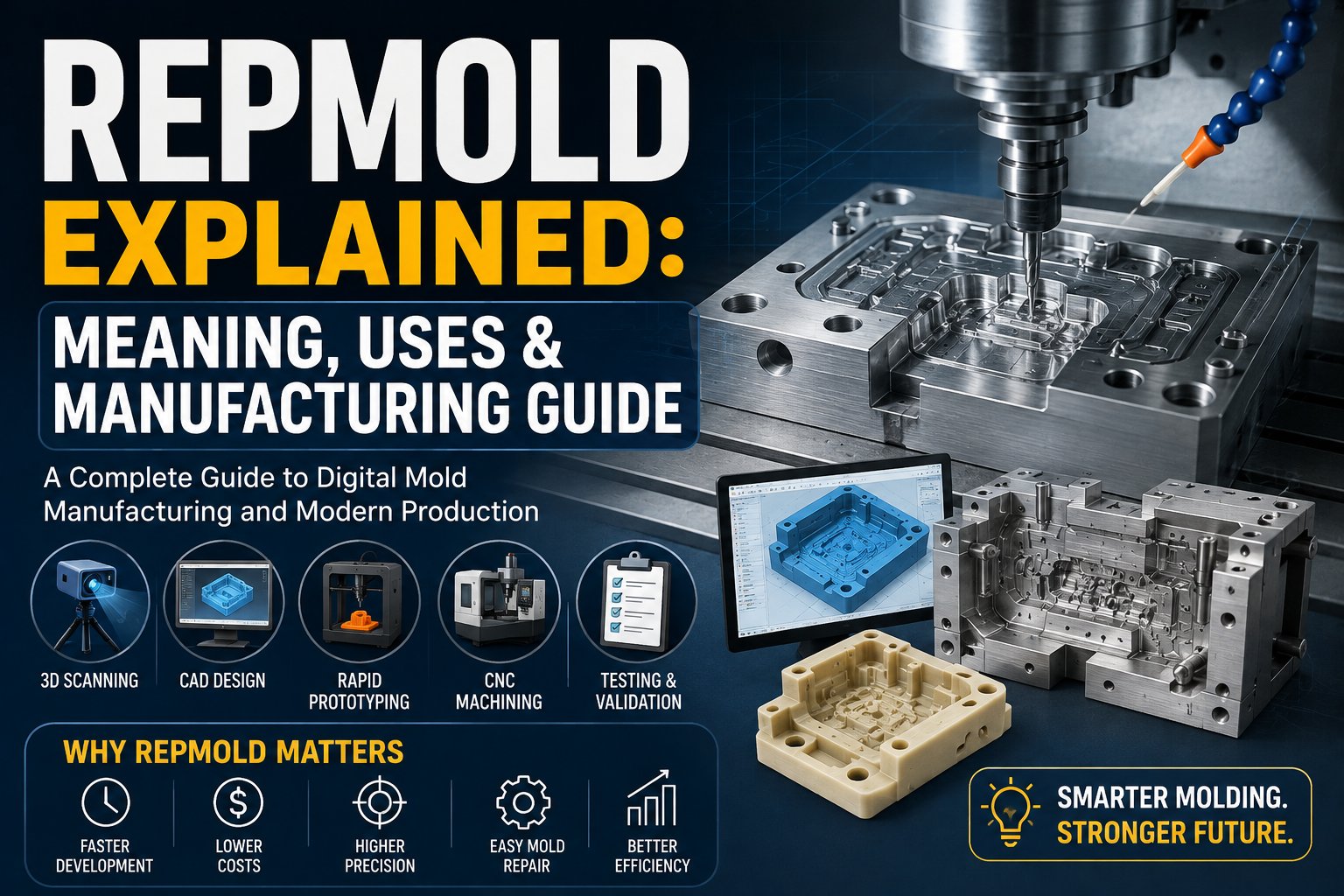
Repmold is generally understood as a digital-first approach to mold creation, replication, repair, and rapid tooling. Rather than relying entirely on traditional machining, it combines modern technologies such as:
- 3D scanning
- CAD (Computer-Aided Design)
- 3D printing
- CNC machining
- Digital inspection
- Mold replication techniques
Although these technologies are well established, the word “Repmold” itself does not have a universally accepted technical definition and should be viewed as an informal industry term rather than an official manufacturing standard.
Why Repmold Is Becoming Popular
Modern manufacturers face increasing pressure to shorten product development cycles while maintaining high precision. Traditional mold production often requires significant time, labor, and cost.
Digital manufacturing workflows associated with Repmold allow companies to:
- Develop prototypes faster
- Repair damaged molds
- Replicate legacy components
- Reduce development costs
- Improve production accuracy
These advantages make the concept attractive across automotive, aerospace, electronics, medical devices, and consumer product manufacturing.
How the Repmold Process Works
Although workflows vary by project, a typical Repmold process follows these stages:
| Stage | Purpose |
|---|---|
| 3D Scanning | Capture the existing part or mold digitally |
| CAD Modeling | Create or modify the digital design |
| Prototype Development | Produce a sample using 3D printing or machining |
| Mold Manufacturing | Build the production mold |
| Testing & Validation | Verify dimensions and performance |
| Production | Manufacture final components consistently |
This workflow allows manufacturers to iterate designs much faster than traditional methods.
Key Technologies Behind Repmold
3D Scanning
High-resolution scanners accurately capture the geometry of existing parts. This is especially valuable when original design files no longer exist.
CAD Design
Engineers refine digital models before manufacturing begins. Small improvements can significantly improve mold performance and product quality.
3D Printing
Additive manufacturing enables rapid prototype creation, helping teams validate designs before investing in expensive production tooling.
CNC Machining
Precision machining produces durable molds suitable for high-volume manufacturing where long tool life is essential.
Applications of Repmold
Repmold-related workflows have practical applications across many industries.
Automotive
Manufacturers use digital mold replication for replacement parts, rapid prototyping, and tooling optimization.
Medical Manufacturing
Medical device companies require extremely accurate molds for surgical tools, diagnostic equipment, and custom components.
Consumer Products
Electronics, packaging, household products, and wearable devices benefit from rapid tooling and shorter production cycles.
Aerospace
Complex geometries and strict tolerances make digital mold development particularly valuable in aerospace engineering.
Benefits of Repmold
One reason Repmold receives growing attention is its ability to combine multiple digital manufacturing technologies into one streamlined workflow.
Major advantages include:
- Faster product development
- Improved manufacturing precision
- Lower prototyping costs
- Easier mold repair
- Reduced material waste
- Better design flexibility
- Faster time-to-market
These benefits help manufacturers remain competitive in increasingly demanding markets.
Is Repmold an Official Manufacturing Technology?
This is one of the most common questions online.
The answer is no.
Unlike injection molding, compression molding, or rotational molding, Repmold is not an officially standardized manufacturing process. Instead, it serves as a convenient label describing several existing technologies working together. Different websites even use the term to describe unrelated software or business platforms, highlighting the importance of verifying the actual context whenever you encounter it.
Repmold vs Traditional Mold Manufacturing
Traditional tooling remains highly effective for large-scale production, but digital-first workflows offer greater flexibility during design and prototyping.
Repmold-style methods excel when manufacturers need rapid iteration, reverse engineering, or low-volume production. Conventional machining often becomes the better option for extremely high-volume manufacturing where tooling durability is the primary concern.
Rather than replacing traditional manufacturing, modern digital workflows complement existing production methods.
Challenges and Limitations
Despite its advantages, Repmold is not without challenges.
High-quality scanners, industrial-grade printers, and precision CNC equipment require significant investment. Skilled engineers are also necessary to manage CAD modeling, inspection, and manufacturing optimization.
Additionally, because Repmold lacks an official definition, online information can sometimes be inconsistent. Companies should evaluate the actual technologies being offered instead of relying solely on marketing terminology.
The Future of Repmold
Manufacturing continues moving toward smarter, data-driven production systems.
Artificial intelligence, digital twins, cloud collaboration, predictive maintenance, and advanced simulation tools are expected to enhance digital mold development even further over the coming years. While these technologies are genuine, they should not automatically be considered part of an official “Repmold platform” unless clearly documented.
As manufacturing evolves, digital replication and rapid tooling will likely become standard practices across more industries.
Conclusion
Repmold represents a growing shift toward digital manufacturing rather than a single standardized technology. By combining 3D scanning, CAD design, rapid prototyping, CNC machining, and mold replication techniques, manufacturers can reduce costs, improve precision, and accelerate product development.
Although the name itself is used inconsistently across the web, the technologies associated with it are transforming modern manufacturing. Understanding the underlying processes—not just the terminology—helps businesses make informed decisions and adopt the right solutions for future production.
Frequently Asked Questions
1. What is Repmold?
Repmold is an informal term commonly associated with digital mold replication, rapid tooling, reverse engineering, and modern mold manufacturing workflows.
2. Is Repmold an official manufacturing technology?
No. It is not recognized as a standardized manufacturing process and is used differently by various sources.
3. Which industries use Repmold-related methods?
Automotive, aerospace, medical manufacturing, consumer electronics, industrial equipment, and product design frequently use these digital manufacturing techniques.
4. Does Repmold rely on 3D printing?
Often, yes. Many projects use 3D printing alongside CAD design, CNC machining, and digital inspection to accelerate development.
5. Why is Repmold becoming more popular?
Businesses increasingly value faster prototyping, lower development costs, greater accuracy, and improved manufacturing flexibility, making digital mold workflows more attractive than ever.